
Common Defenses Used in DUI Cases
A DUI charge can feel overwhelming, but there are proven ways to challenge one. A defense may question the accuracy of the breath or blood test, the legality of the traffic stop, or whether your rights were respected during the arrest. If any of those steps went wrong, key evidence may be weakened or excluded.
Every case is different, and consulting with a skilled Marietta DUI defense attorney can provide more personalized strategies. Here are the defenses that come up most often in Georgia DUI cases.
How DUI Charges Work in Georgia
Blood Alcohol Concentration (BAC)
BAC measures the amount of alcohol in your bloodstream. In Georgia, a BAC of 0.08% or higher for drivers 21 and older can lead to a per se DUI charge, which means no further proof of impairment is needed. The limit is lower for commercial drivers and for drivers under 21.
You can also be charged with DUI below those limits if alcohol or drugs made you a less safe driver.
Traffic Stops and Reasonable Suspicion
Most DUI cases begin with a traffic stop. For the stop to be legal, police need a valid reason, such as erratic driving or a traffic violation. Once you're stopped, the officer may look for signs like slurred speech or the smell of alcohol and ask you to take field sobriety tests or a breath test.
Miranda warnings are a separate issue. They generally apply before custodial interrogation, not at the start of every traffic stop. Your attorney can review when and how you were questioned.
Common Defenses in DUI Cases
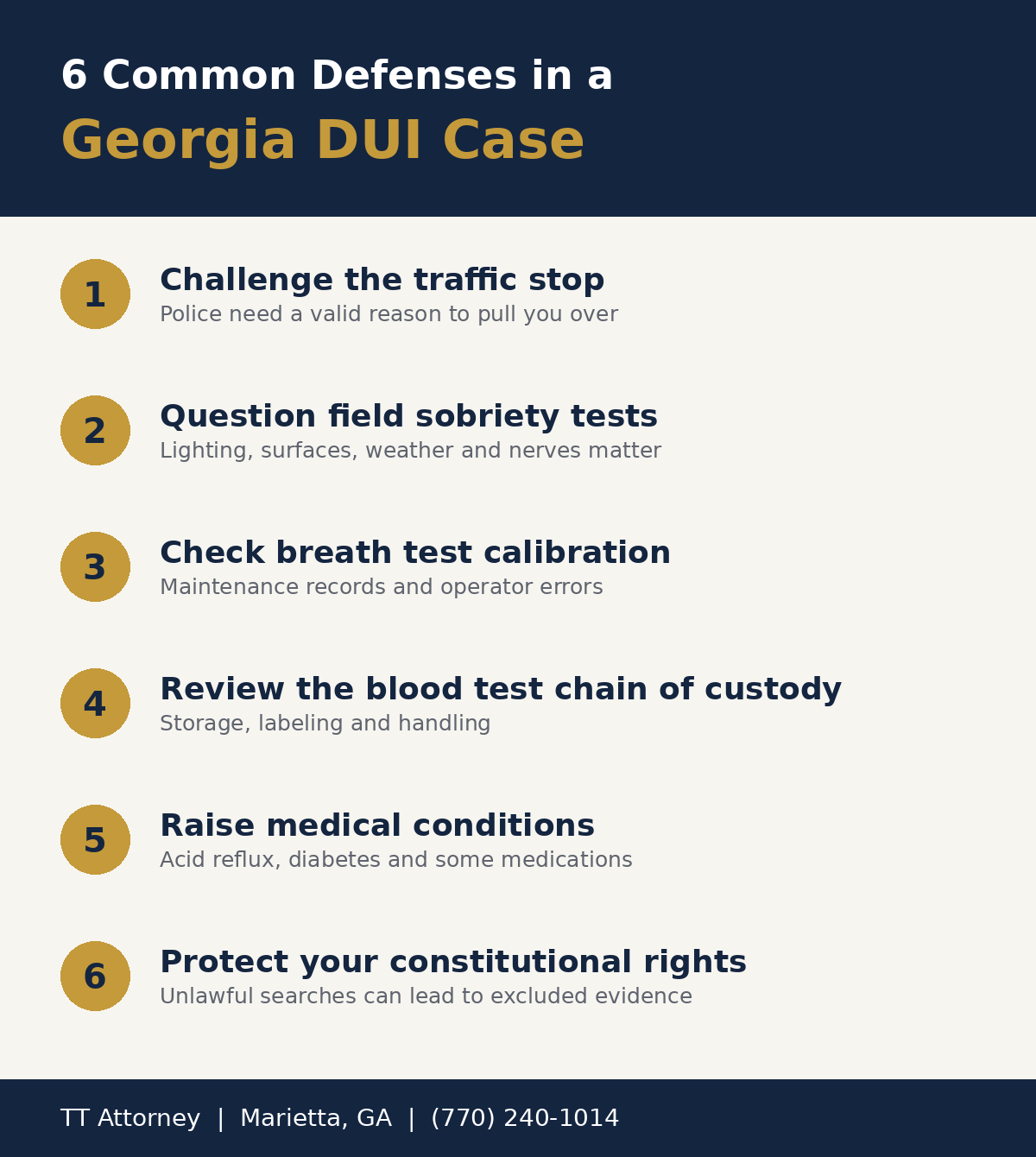
Challenging the Traffic Stop
If the officer didn't have a valid reason to stop you, evidence gathered afterward may be challenged and possibly excluded. That can change the outcome of the whole case.
Questioning Field Sobriety Tests
Field sobriety tests, including the walk-and-turn, the one-leg stand, and the horizontal gaze nystagmus test, measure balance, coordination, and attention. They aren't always reliable. Poor lighting, uneven pavement, bad weather, nerves, or medical conditions such as inner ear disorders can all affect how you perform.
Breath Test Calibration and Reliability
Breath test machines have to be properly calibrated and maintained to give accurate readings. If the calibration records show problems, or if the officer made mistakes running the test, the results can be challenged.
Blood Tests and Chain of Custody
Blood and urine samples require careful handling. Your attorney can verify each step, from collection to storage to transport. Contamination, mislabeling, or missing documentation can raise questions about whether the results are reliable.
Medical Conditions and Medications
Some medical conditions can affect test results. Acid reflux (GERD) can bring alcohol from the stomach into the mouth and skew a breath test, and conditions like diabetes and hypoglycemia can affect results too. Certain medications can also interfere. Your attorney can look at whether any of these factors played a role.
Constitutional Rights and Unlawful Searches
The Fourth Amendment protects you from unreasonable searches and seizures. If police lacked probable cause to arrest you, or a search was done improperly, evidence may be excluded, which can weaken the prosecution's case.
What's at Stake
A DUI conviction can lead to a license suspension, fines from several hundred to thousands of dollars, court costs, DUI school fees, and higher insurance premiums. A conviction also creates a criminal record that can show up in background checks and affect jobs that involve driving. For a full breakdown of Georgia penalties, see Understanding DUI Laws in Marietta.
Talk With TT Attorney About Your Defense
The right defense depends on the facts of your arrest. If you're facing a DUI charge in Marietta or Cobb County, contact TT Attorney to review the stop, the testing, and the evidence in your case.