
Before hiring an injury lawyer in Georgia, review the work being accepted, the fee and expense terms and how decisions will be made. Your lawyer can assess facts and law, explain options and carry out the agreed representation. No lawyer can promise what an insurer, judge or jury will decide.
A useful hiring discussion identifies who the client is, which claims and stages the agreement covers, who will do the work and how the client will receive information. Use those answers to understand the proposed arrangement before giving instructions or signing.
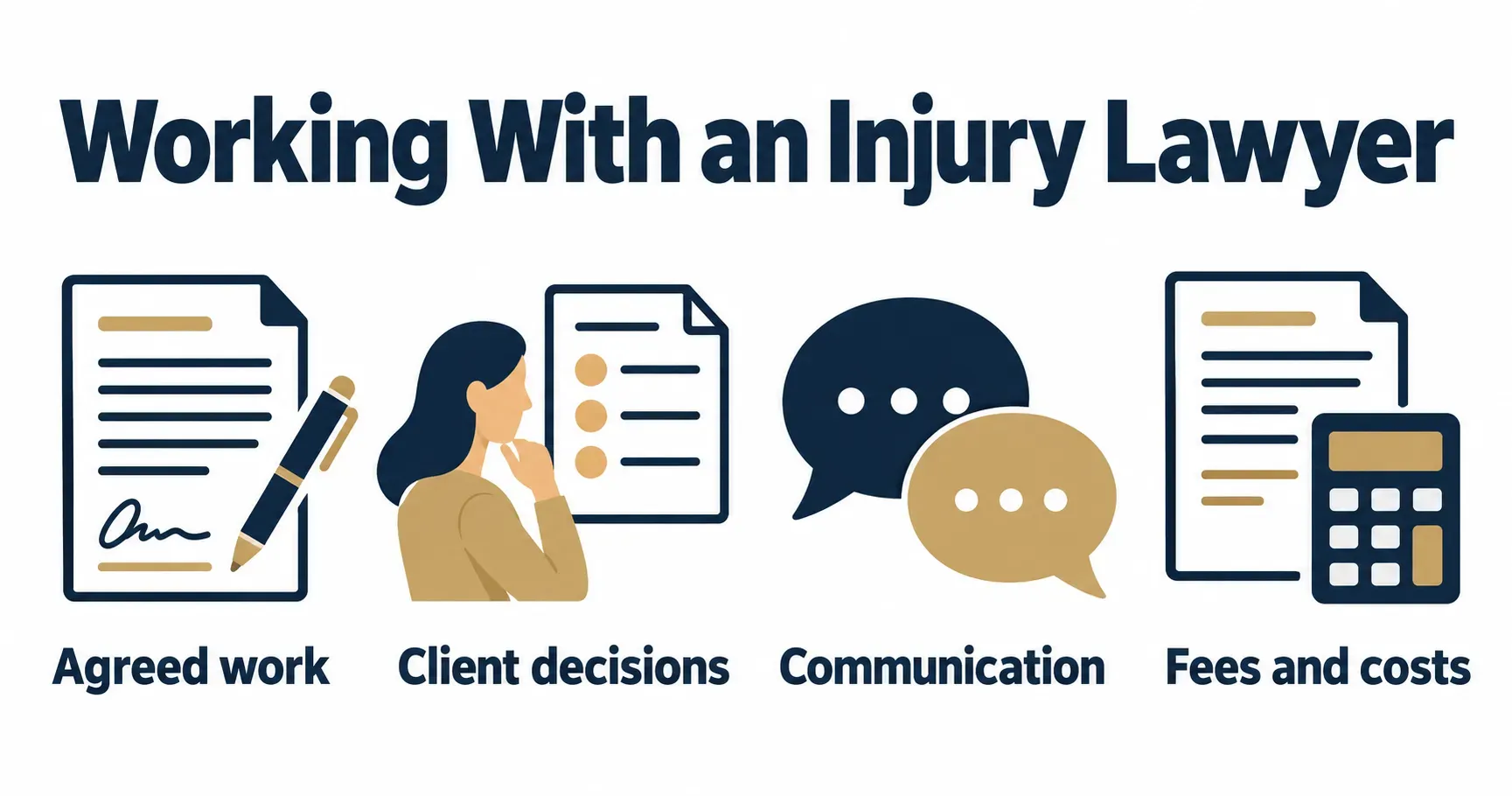
What Legal Representation Can Address
An injury claim can involve disputed responsibility, medical evidence, insurance coverage and procedural requirements. Your lawyer can identify the legal questions, assess available evidence and explain the options within the accepted work. The facts and governing law determine what must be proved.
The legal work may include investigating events, obtaining records, communicating with insurers, negotiating or conducting litigation. Ask which tasks the proposed agreement includes. Hiring a lawyer for a claim does not establish that every lawsuit, appeal or separate legal issue is covered.
For the broader claim paths and legal questions, read the Georgia personal injury claims article. For reviewing an offer, release and possible net proceeds, use the injury compensation review article.
Check the Lawyer and the Fit for the Work
The State Bar of Georgia member directory provides membership, contact and public disciplinary information. Check the identity of the person you are considering and the status information shown by the official source. A directory listing is not a prediction of results or certification that the lawyer handles every type of injury claim.
Georgia Rule 1.1 requires competent representation. Ask about experience relevant to the legal issues in your case, preparation needed and any limits on the work the lawyer is accepting. A title, advertisement or general practice description does not answer every question about the proposed representation.
- Who would handle the legal work and who would be the contact for updates?
- Would another lawyer, firm or outside professional be involved, and how would that affect the agreement or costs?
- Which claim types, parties and stages would be included?
- What information is needed before the lawyer can decide to accept the case?
- What communication method and accessibility or language arrangements can be agreed?
Ask about staffing, specialist credentials, court work and fee terms for the proposed representation. Confirm who would accept the case and what work that acceptance would cover.
An Initial Inquiry and an Accepted Case Are Different
Contacting a lawyer starts a discussion about possible representation. Confirm what the lawyer has agreed to do and what remains undecided. Do not assume that submitting a web inquiry, leaving a message or attending a consultation means someone has accepted responsibility for every deadline or claim.
Georgia Rule 1.18 addresses prospective clients. Duties concerning information received during a consultation can arise even when representation does not follow. The circumstances of the consultation affect those duties; an unanswered inquiry and an accepted case should not be treated as interchangeable.
Before sending extensive sensitive documents, ask what information is needed to check the parties and consider the proposed work. Confirm how documents should be sent. Keep your own copies of notices and dates while the acceptance and scope questions are being resolved.
Identify the Client and Possible Conflicts
An incident may involve injured people, a parent and child, family members, a business or a person acting for someone else. Identify who would be the client and who has authority to give instructions. Paying a fee or helping with paperwork does not itself answer those questions.
Georgia Rule 1.7 restricts representation affected by conflicts of interest. Some conflicts can prevent representation; consent is not available in every situation. Give the names of relevant parties early and ask about any separate representation needs. People injured in the same incident do not necessarily have identical interests.
Read the Scope Before Agreeing to Representation
The agreement should identify the work being accepted and any limits. Georgia Rule 1.2 permits a reasonable limitation on the scope of representation with the client's informed consent. A limit needs to be understood in the context of the case, including work someone else will need to address.
- Which incident, claims and clients does the agreement cover?
- Does it cover investigation and insurance negotiations, filing a lawsuit, trial and any appeal?
- Are other proceedings, benefits questions or separate claims excluded?
- Who will monitor the relevant dates and carry out any excluded work?
- How will a change in the accepted work, fee or expense arrangement be discussed and documented?
Ask for an explanation if a stage or claim is unclear. A lawyer accepting negotiations may not be accepting an appeal or an unrelated dispute. The arrangement should leave the client able to identify the work being undertaken and the questions requiring separate advice.
- Accepted work
- Identify the claims, stages and clients covered.
- Excluded work
- Ask what requires separate advice or another agreement.
- People and updates
- Confirm who will do the work and how information will be shared.
- Fees and expenses
- Read the calculation, responsibility and payment terms.
Dates and Notices Need Attention During Hiring
Give the lawyer every available court paper, insurer letter, government notice and document stating a response date. Injury claims can have filing limits, and some claims involve separate notice requirements. The responsible parties and type of claim can change the analysis.
Do not assume that a consultation request or insurance discussion extends a filing or notice period. Ask who has accepted responsibility for the dates while representation is being considered. The general claims article discusses deadline questions; an individual date requires review of the facts and applicable law.
Client Decisions and the Lawyer's Work
Georgia Rule 1.2 states that the client controls the decision to settle a civil case. The lawyer provides advice and carries out the accepted legal work within the governing rules. A recommendation to accept an offer is not the client's acceptance of it.
Discuss the client's objectives and the means of pursuing them. Ask what decisions need instructions, what work your lawyer can carry out under the agreement and how consent will be recorded. A client cannot require unlawful conduct, false evidence or a violation of the lawyer's professional duties.
An Offer Needs an Informed Decision
Ask your lawyer for an explanation of the offer, release, disputed issues and practical alternatives. The discussion should include the obligations being accepted and the costs and risks of further work. A settlement amount alone does not explain which claims or parties would be released.
Georgia Rule 1.4 addresses communication needed for informed decisions. Settlement offers should be communicated and explained as required by that rule. Discuss what instructions your lawyer may rely on and ask about an offer you do not understand before authorizing acceptance.
If a child, estate or person acting through a representative is involved, the person giving instructions may need legal authority and a settlement may require approval. The client decision principle does not remove requirements governing a representative or tribunal approval. Ask which requirements apply to that client and claim.
- Client objectives
- Discuss what the client seeks and what instructions are needed.
- Settlement choice
- The settlement decision belongs to the client, subject to applicable authority and approval requirements.
- Lawyer’s advice
- Ask for an explanation of options, terms, risks and obligations.
- Agreed work
- Confirm what your lawyer may carry out within the representation.
Agree How Information Will Be Shared
Discuss communication arrangements at the start of representation. Ask who handles routine updates, how to send documents and how to raise a question requiring legal advice. Agree how the lawyer can reach you when a decision or response is needed.
Rule 1.4 requires communication about the status of the work and explanations sufficient for informed decisions. It does not supply a promised response interval for this firm. Ask about the proposed arrangements instead of relying on a general expectation of immediate replies.
- Report a change in contact details or availability.
- Send new notices, insurer communications and relevant records promptly.
- Tell your lawyer about earlier incidents, prior claims and information that may weaken the position.
- Ask what a status update means, what work remains and what decision is needed from you.
- Keep copies of instructions, case documents and the agreed communication arrangements.
If you cannot understand an explanation, ask for it in another form or with the relevant document identified. Request a discussion of an unresolved concern. Silence or an unclear status message should not be treated as approval of a legal decision.
Fees and Case Expenses Need Separate Terms
The fee pays for legal services. Case expenses concern items such as records, filing, depositions or outside professional work. The agreement needs review for both. A contingency fee does not, by itself, answer every question about expenses or financial responsibility.
Georgia Rule 1.5 requires a written contingency fee agreement stating the method of calculation. It addresses the percentage or percentages applicable to settlement, trial or appeal and how litigation and other expenses affect the calculation. Do not assume that every lawyer charges the same percentage or uses the same expense terms.
Questions to Resolve Before Signing
- What fee method applies, and how is the fee calculated at the stages covered?
- Which expenses could be charged, who advances them and who is responsible for repayment?
- Are expenses deducted before or after the contingency fee is calculated?
- What would be owed, if anything, if there is no recovery?
- How are costs for outside professionals or unusually large expenses discussed?
- What happens to fees and expenses if the accepted work changes or representation ends?
- What closing statement and accounting will explain the result and deductions?
Read the written terms before relying on phrases such as no fee or contingency. Ask separately about the consultation, any advance, case expenses and obligations if no compensation is received. Ask for the proposed percentage, payment terms and any expense obligation in writing.
If another lawyer or firm is to be involved, ask how that arrangement affects responsibility, communication and fees. Ask for any required explanation or consent before treating a referral or shared work arrangement as part of the original agreement.
- Fee method
- Check how the fee is calculated for the work covered.
- Case expenses
- Identify who advances and repays expenses.
- Calculation order
- Ask when expenses are deducted in the calculation.
- No recovery or a change
- Read the terms for no recovery, changed work or ending representation.
Records Help a Lawyer Assess the Claim
Bring information about the incident, possible witnesses, photographs, available reports, medical records, bills, missed work and insurer correspondence. Identify what each document shows and where it came from. A report or record may support part of the claim without resolving every disputed fact.
Keep original records and relevant messages, including information that may be unfavorable. Ask about preserving photographs, video, physical items and electronic communications. Do not alter a document, manufacture a description or remove material to make the case appear stronger.
Discuss social media and other communications about the case with your lawyer. A request to preserve information and advice about future communications are different from permission to conceal or destroy evidence. Describe events accurately and identify uncertainty rather than filling gaps with assumptions.
Medical Evidence and Care Have Different Roles
Treating professionals address medical care. Your lawyer can review records and explain their legal relevance, including questions about causation, expenses and the effect of an injury. A legal consultation does not replace medical advice or direct a treatment change.
Georgia's 2025 medical damages legislation can affect the proof of recoverable medical expenses, with applicability tied to when the legal claim arose. Ask what treatment, billing and payment records are needed for the law governing your claim. A bill total is not a promised award.
Give accurate information about symptoms, earlier conditions, treatment and work effects. Ask your lawyer how disputed or incomplete records will be addressed. The legal review should distinguish what a document records from what remains to be proved.
Understand Confidentiality and Privilege
Georgia Rule 1.6 governs a lawyer's ethical duty concerning client information, subject to the rule's conditions and exceptions. That duty and the evidentiary attorney-client privilege are different legal protections. Protection depends on the communication, the circumstances and applicable exceptions.
Ask how to communicate about the representation, who may receive information and what role a family member, insurer or other person will have. Copying another person or sharing legal advice can raise questions about privilege or confidentiality. Discuss the circumstances before assuming a message has the same protection after it is shared.
Prospective client information has its own rules even if the lawyer does not accept the work. Ask what information is needed for the initial discussion and how it will be handled. Do not treat a general website as a secure case file or an assurance of representation.
Negotiation, a Lawsuit and Trial Depend on the Case and Agreement
Your lawyer may advise negotiating, requesting more information, filing a lawsuit or considering another available course. The choice depends on evidence, legal requirements, coverage, client objectives and the accepted work. A failed negotiation does not automatically require a trial, and filing a lawsuit does not guarantee a favorable result.
Ask what work would follow a disputed offer or a filing decision and what expenses could be incurred. Confirm the stage covered, who would handle it and the client responsibilities before authorizing further work.
Georgia Rule 1.3 requires reasonable diligence and promptness in entrusted work. Professional duties do not remove disputed facts, procedural requirements or decisions made by other participants. Ask for the assessment and available options without treating a confident prediction as a guaranteed outcome.
Understand the Closing Statement and Any Funds Held
At the end of a contingency fee case, Rule 1.5 requires a written statement describing the outcome and, if there is a recovery, the remittance and method of calculation. Review the fee, expenses and other deductions to determine the amount available to the client.
Some claims involve repayment questions or legally recognized third-party interests. Rule 1.15 addresses safeguarding and accounting for funds, including disputed interests. Ask what money is being distributed, what is being held, why it is held and how any dispute will be addressed.
An unpaid bill is not automatically an enforceable lien, and a potential repayment issue does not establish that all money must be held indefinitely. The applicable right and amount need review. The separate compensation review article discusses offer terms, repayment questions and the distinction between gross and possible net proceeds.
If Representation Ends or You Consider Another Lawyer
Discuss unresolved concerns and ask for the case status, relevant dates and accounting information. If you are considering another lawyer, find out what work has been completed, what remains and how a transition would be handled. A change of lawyer does not itself extend a deadline.
Georgia Rule 1.16 requires steps to protect a client's interests when representation ends. These can include reasonable notice, time to obtain another lawyer, surrender of papers and property to which the client is entitled and refund of any advance fee payment that has not been earned.
A lawyer must comply with applicable rules and tribunal orders about ending representation and may be required to continue despite a reason to withdraw. Ask about any court action needed, file transfer, outstanding expenses and fee issues. Do not assume that every transfer is immediate, free or free of unresolved financial questions.
- Case status and dates
- Identify completed work, remaining tasks and relevant dates.
- File and property
- Ask what must be transferred and how it will be delivered.
- Fees and accounting
- Review earned fees, expenses and any unearned advance.
- Court requirements
- Check any required permission or continued representation.
If the concern involves professional conduct or fees, ask about the relevant State Bar information and the available procedure. A professional complaint, fee disagreement and civil claim are different issues. Do not assume that a complaint determines compensation, changes a judgment or protects a filing date.
Questions to Take to a Hiring Discussion
- What work are you considering accepting, and what information do you need to decide?
- Who would be the client and who would carry out the work?
- Which claims, stages and dates would you handle?
- What decisions require my instructions, and how will offers be explained?
- How will we exchange records, communicate and address unanswered questions?
- How do the written fee and expense terms work if the case ends with or without a recovery?
- What happens to the file, dates, fees and expenses if representation ends?
Bring the documents you have and identify any stated dates. A complete file may not be available during the initial discussion. Ask what is needed for the particular decision and confirm the scope of any work accepted.
Discuss the Proposed Work With TT Attorney
You can contact TT Attorney about an injury claim and ask about the work the firm may accept, communication arrangements, fees and case expenses. Have incident information, available records and any insurer or court notice ready if you can. You can make an inquiry with the information you already have.
Read about personal injury representation or call TT Attorney at 770-240-1014. Confirm any agreed work and financial terms before relying on an arrangement. An inquiry does not promise acceptance of the case or a particular recovery.
This information describes general representation questions in Georgia. It does not determine the duties, agreement or outcome in an individual case.